Revenue rises to KRW 3.58 trillion year-on-year narrowing operating loss by around 64%, driven by ESS order growth, strengthened supply chains and portfolio diversification
Earnings to improve gradually as demand recovers across key markets, raising expectations that the company would return to quarterly profitability in the second half
SAMSUNG SDI today reported financial results for the first quarter that ended March 31, 2026.
The company reported revenue of KRW 3.58 trillion ($2.43 billion) and an operating loss of KRW 155.6 billion. Revenue increased 12.6% year-on-year, while operating loss narrowed by 64.2%. The company posted KRW 56.1 billion in net profit, returning to profitability.
The battery business generated KRW 3.35 trillion in revenue with an operating loss of KRW 176.6 billion, while electronic materials business recorded KRW 222 billion in revenue and an operating profit of KRW 21 billion.
The battery business performance improved as demand recovered across key applications such as energy storage systems (ESS), uninterruptible power supply (UPS), battery backup units (BBU), and power tools. Revenue grew 12.5% year-on-year, with losses narrowing by more than 61%.
Such improvement was contributable to increased Advanced Manufacturing Production Credit (AMPC) benefits, driven by expanded U.S.-based production and sales of ESS batteries, as well as higher sales of high-value cylindrical batteries.
The electronic material business delivered solid growth, supported by steady semiconductor materials demand and rebound in display materials sales, driven by stronger flagship smartphone shipments from major customers.
Business Highlights for First Quarter 2026
As key achievements during the quarter, SAMSUNG SDI cited expanded ESS orders, further diversification on its EV battery customer and product portfolio, and continued progress in strengthening next-generation technology capabilities.
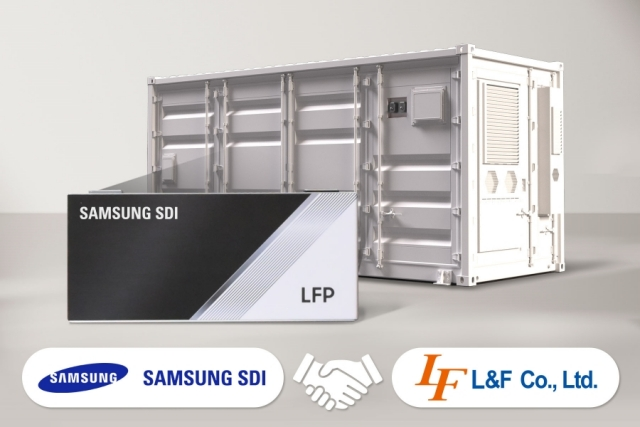
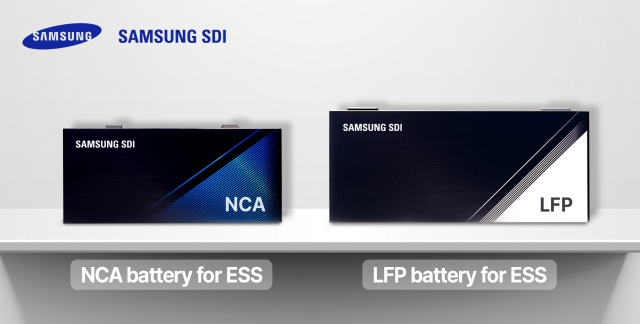
In the ESS battery segment, the company secured new prismatic LFP battery projects and signed supply agreements for high-power BBU batteries. It also proactively established a materials supply chain to address the United States’ Prohibited Foreign Entity (PFE) regulations, laying the foundation for sustained growth.
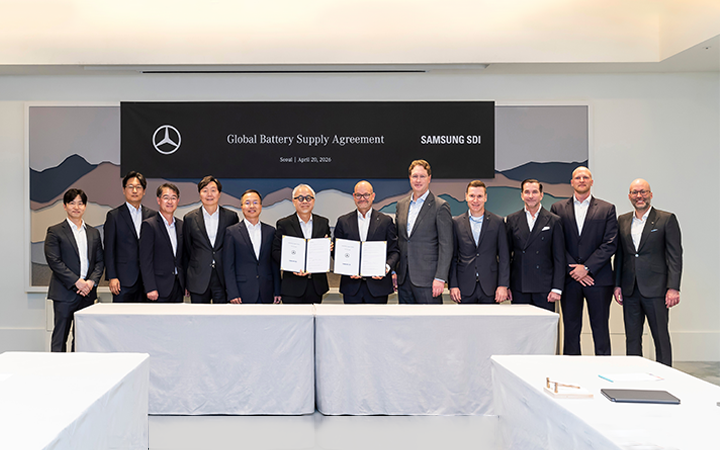
In the EV battery sector, SAMSUNG SDI singed a multi-year supply agreement with Mercedes-Benz, securing all three major German premium automakers as customers. The company also diversified its product portfolio by winning a project to supply tabless cylindrical batteries for hybrid electric vehicles.
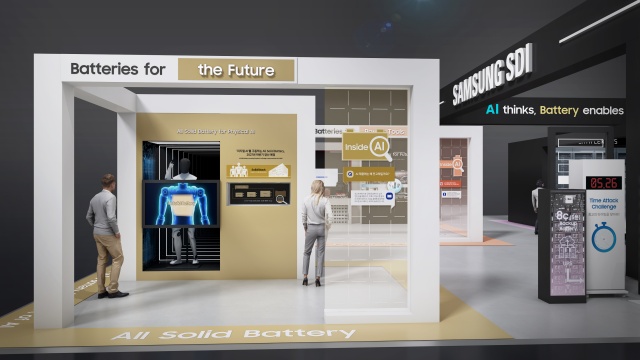
At InterBattery 2026, the largest battery tradeshow held in Seoul in March, SAMSUNG SDI unveiled a pouch‑type all‑solid‑state battery sample under development for physical AI application. The company has also further strengthened its future technology competitiveness by announcing a solution to improving the lifespan and safety of next‑generation lithium‑l battery.
Business Outlook for the Second Quarter 2026
SAMSUNG SDI expects a gradual recovery in performance starting from the second quarter, supported by improving demand conditions.
In the EV battery segment, demand is expected to pick up driven by expanded incentives in Europe and rising total cost of ownership (TCO) for internal combustion engine vehicles. The company will focus on ramping up new projects as planned while improving profitability through higher utilization.
For the ESS battery business, SAMSUNG SDI plans to scale up U.S. production and sales to meet growing demand from AI data centers, while also actively participate in Korea’s government‑led bidding for ESS battery supplies for state‑run power companies and next‑generation grid projects.
For its small battery business, the company aims to drive growth with differentiated products such as tabless and high power batteries, supported by continued growth in the BBU and power tool markets resulting from increased AI data center construction, as well as a recovery in micro‑mobility demand.
In the electronic materials segment, SAMSUNG SDI expects solid demand for semiconductor and OLED materials to continue and plans to expand sales of advanced patterning materials and OLED solutions.
“Uncertainty in the global business environment is expected to persist in the second quarter as well,” said a company official. “We will continue efforts to execute our strategies across all business areas smoothly as planned and to swing to a quarterly profit in the second half of the year.”